


Sintered Connecting Rod
Bearing and Bush Co, established in 1997, is recognized as one
of the foremost manufacturers and exporters of a diverse range
of products including bearings, bushes, dry washers, flanged
washers, automotive washers, pump washers, metal washers, and
components utilized in the automotive sector.
We have built a reputation for maintaining a high level of
consistency in the quality of our products and services, such
as dry washers, flanged washers, automotive washers, pump
washers, and metal washers.
Additionally, we offer customized solutions tailored to the specific requirements of our clients.
Bearing and Bush Co, globally Export to Gulf and African countries. Our products, including Dry Washers, Flanged Washers, Automotive Washers, Pump Washers, And Metal Washers, are renowned globally for their dimensional accuracy, tensile strength, and durability. Each product undergoes rigorous testing and is meticulously managed to ensure superior performance in accordance with industry-leading standards.
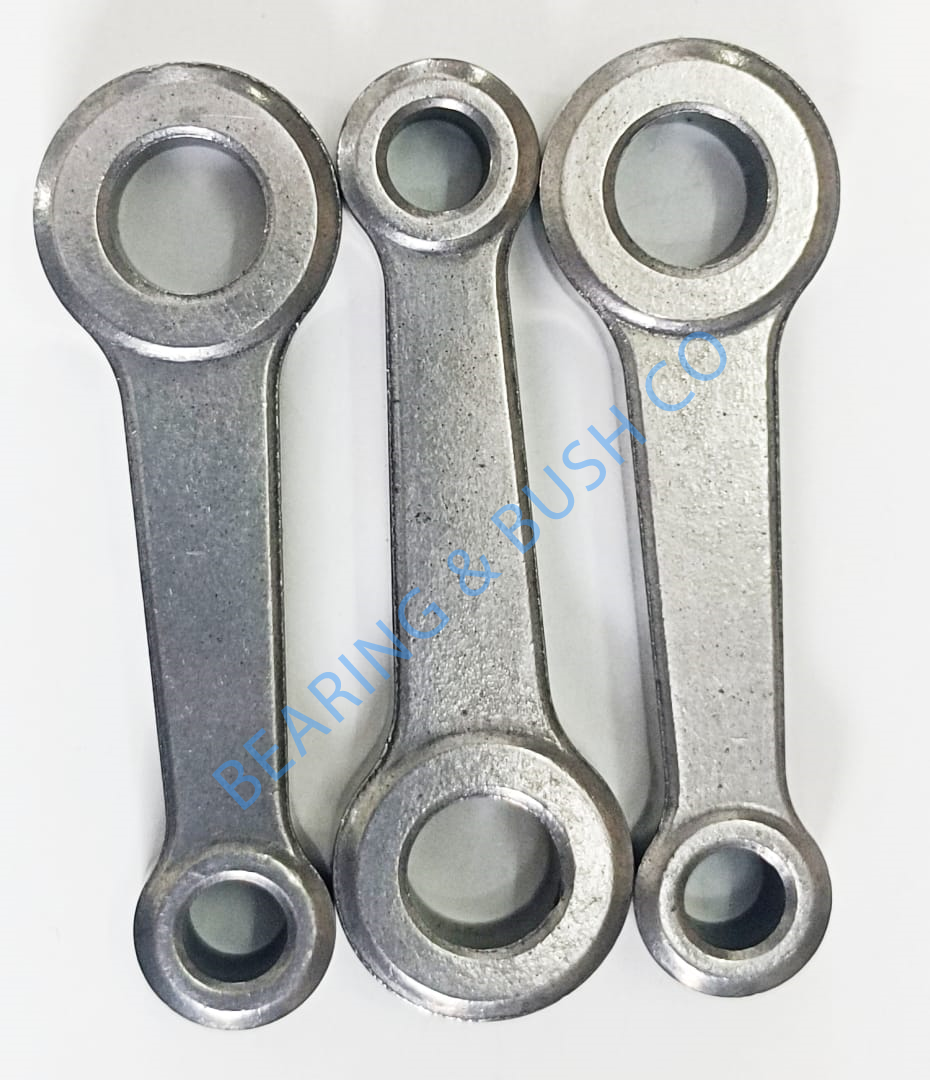

Sintered Connecting Rod :-
A Sintered Connecting Rod is a precision-engineered mechanical component manufactured using powder metallurgy technology. It connects the piston to the crankshaft in engines and compressors, transmitting motion and force efficiently. Sintered connecting rods are widely used in automotive engines, air compressors, refrigeration systems, motorcycles, and industrial machinery due to their excellent dimensional accuracy, strength, and cost-effectiveness.
The sintering process involves compacting metal powders into a mold and heating them below their melting point to form a dense, durable component with consistent mechanical properties.
Key Features of Sintered Connecting Rods
- Precision Dimensional Accuracy -Powder metallurgy manufacturing ensures close tolerances and reduces the need for secondary machining operations.
- Lightweight Construction - These connecting rods are lighter than conventionally forged components, helping improve operational efficiency and fuel economy.
- Excellent Wear Resistance - The sintered structure offers superior resistance to wear and friction, increasing service life.
- Cost-Effective Production - Mass production through powder metallurgy reduces material wastage and manufacturing costs.
- Uniform Material Properties- The controlled sintering process ensures consistent density and uniform performance throughout the component.
Working Principle of Sintered Connecting Rod
A Sintered Connecting Rod works by transferring the reciprocating motion of the piston into rotary motion at the crankshaft in an internal combustion engine or compressor system. It is manufactured using powder metallurgy technology, where metal powders are compacted and sintered to create a high-strength, precision-engineered component.
Step-by-Step Working Principle
During engine operation, combustion pressure pushes the piston downward inside the cylinder. This creates linear or reciprocating motion. The small end of the sintered connecting rod is attached to the piston pin, while the big end is connected to the crankshaft journal. The rod transmits the force generated by the piston to the crankshaft. As the connecting rod moves up and down with the piston, the crankshaft rotates. This converts reciprocating motion into rotary motion, which powers the engine or mechanical system.
The sintering process provides uniform density and dimensional accuracy, helping the rod perform efficiently under repeated stress conditions.
Many sintered connecting rods include oil passages or porous structures that assist in lubricant retention and smooth operation, reducing friction and wear between moving components.
Materials Used in Sintered Connecting Rods:
- Iron-based powders
- Alloy steel powders
- Copper steel composites
- Nickel alloy powders
- Graphite-enhanced metal powders
How Powder Metallurgy Improves Performance
The powder metallurgy manufacturing process enhances the working efficiency of sintered connecting rods by offering:
- High dimensional precision
- Reduced machining requirements
- Uniform material structure
- Improved wear resistance
- Better fatigue strength
This makes sintered connecting rods suitable for high-volume automotive and industrial applications.
Types of Sintered Connecting Rods:
Sintered connecting rods are manufactured using powder metallurgy technology dimensional accuracy, and cost efficiency for automotive and industrial applications. Depending on design, material composition, and application requirements, sintered connecting rods are available in several types.
Different types of sintered connecting rods are designed to meet varying engine speeds, and industrial requirements. Their precision manufacturing, and cost-effective production make them widely used in modern automotive and engineering applications.
- Fracture Split Sintered Connecting Rods:These connecting rods are manufactured as a single piece and then intentionally fractured at the bearing cap area to create perfectly matching surfaces. They have excellent alignment accuracy and rigidity, reduced machining requirements & better cap positioning during assembly. These are more used in Passenger cars, Motorcycles, High-speed automotive engines.
- Conventional Sintered Connecting Rods - These are standard powder metal connecting rods manufactured using compaction and sintering processes without fracture splitting. They possess economical manufacturing, good wear resistance, suitable for moderate load applications, consistent dimensional precision. They are more used in Small engines, Compressors & Agricultural equipment.
- Lightweight Sintered Connecting Rods - They are designed with optimized geometry and lightweight materials to reduce engine weight and improve efficiency. They have reduced reciprocating mass, improved fuel efficiency, lower vibration and better engine responsiveness. More used in Racing engines, Two-wheelers and Compact automotive engines.
- High-Density Sintered Connecting Rods - Produced using advanced densification techniques to achieve near-forged mechanical properties. These Rods have superior structural integrity, high fatigue resistance, better impact strength and are suitable for extreme operating conditions. They are widely used in Turbocharged engines, Heavy industrial equipment, and High-performance automotive systems.
Applications of Sintered Connecting Rods
Sintered connecting rods are widely used in industries where dimensional accuracy, lightweight construction, and cost-effective mass production are essential. These rods are manufactured using powder metallurgy technology, making them suitable for precision-engineered mechanical systems.
- Automotive Industry - Sintered connecting rods are extensively used in Passenger cars, Motorcycles, Scooters, Commercial vehicles, Diesel and petrol engines.
- Agricultural Machinery - These Rods are used in Tractors, Harvesters, Power tillers, Irrigation equipment.
- Power Generation Equipment - They are used in Diesel generator engines, Gas-powered generators, Backup power systems. These rods offer excellent fatigue strength for long-duration engine performance.
- Marine Applications - Sintered connecting rods are used in Small marine engines, Boat engines , Outboard motors. They provide corrosion resistance and dependable mechanical strength in marine conditions.
- Two-Wheeler Industry - Widely utilized in Bikes, Mopeds, Racing motorcycles. Their lightweight construction contributes to better fuel efficiency and engine responsiveness.
- Robotics and Specialized Mechanical Systems - Used in Automated mechanical assemblies, Compact motion systems, Precision mechanical devices . Their dimensional consistency and durability support smooth repetitive motion.
- Industrial Machinery - Applied in Air compressors, Hydraulic systems, Pneumatic equipment, Industrial pumps. Their high load-bearing capacity and precision manufacturing ensure smooth machine operation.
Frequently Asked Questions
Are sintered connecting rods strong enough for high-performance applications? ▼
Yes, modern sintered connecting rods provide excellent fatigue resistance, making them suitable for many high-performance and heavy-duty applications.
How do sintered connecting rods reduce production costs? ▼
Powder metallurgy minimizes raw material wastage and reduces secondary machining operations, resulting in lower overall manufacturing costs.
Can sintered connecting rods be customized? ▼
Yes, manufacturers can customize dimensions, material composition, surface treatments, and mechanical properties according to specific application requirements.
Are sintered connecting rods corrosion resistant? ▼
Yes, sintered connecting rods can be made corrosion resistant through appropriate material selection and surface treatments, depending on the operating environment.
What industries benefit most from sintered connecting rods? ▼
Industries such as automotive, agriculture, construction equipment, and industrial machinery benefit greatly from the durability, precision, and cost-effectiveness of sintered connecting rods.
How is the quality of sintered connecting rods tested? ▼
Quality checks typically include dimensional inspection, density testing, mechanical property evaluation, hardness testing, and visual inspection to ensure consistent performance and reliability.
Why are sintered connecting rods popular in the automotive industry? ▼
Sintered connecting rods offer lightweight construction, high production efficiency, consistent quality, excellent strength, and reduced manufacturing costs, making them ideal for modern automotive engines.