


Half Shell Bearings
Bearing and Bush Co is recognized as one of the premier manufacturers and exporters of a diverse range of products including bearings, bushes, dry washers, flanged washers, automotive washers, pump washers, metal washers, and components utilized in the automotive sector.
Our products, including dry washers, flanged washers, automotive washers, pump washers, and metal washers, are renowned globally for their dimensional accuracy, tensile strength, and durability.
We have our Global presence specially in the Arifcan and Middle East countries.
Half Shell Bearings, also known as Split Plain Bearings, Journal Bearing Shells, or Engine Bearing Shells, are semi-circular bearing components designed to support rotating shafts under high radial loads. Two matching half shells are assembled together to form a complete bearing around the shaft, making installation and maintenance easier without dismantling the entire shaft assembly. Half-shell or split plain bearings are commonly used where shafts cannot be removed easily, such as crankshafts and heavy industrial equipment.
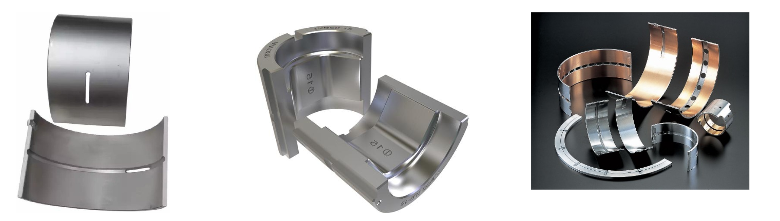
Key Features of Half Shell Bearings
- Split design for easy assembly and replacement
- High load-carrying capacity
- Excellent fatigue and wear resistance
- Precision-machined for accurate shaft support
- Available with lubrication grooves and oil holes
- Suitable for continuous and heavy-duty operation
- Compact design with low operating noise
Working Principle of Half Shell Bearings
A Half Shell Bearing consists of two semi-circular bearing shells that fit together inside a bearing housing around a rotating shaft. The working principle is based on hydrodynamic lubrication, where a thin film of lubricant separates the shaft from the bearing surface during operation.
Two half-shells are mounted inside the housing, forming a complete circular bearing around the shaft. Oil or grease is supplied through lubrication grooves or oil holes present in the bearing shell. As the shaft starts rotating, it drags the lubricant into the clearance space between the shaft and bearing. Due to shaft motion and pressure buildup, a thin lubricant film forms between the shaft and bearing surface. The oil film carries the applied load, preventing direct metal-to-metal contact. The lubricant minimizes friction, reduces wear, and helps dissipate heat generated during operation.
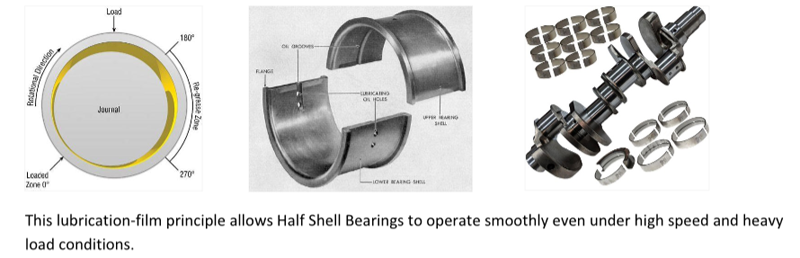
Types of Half Shell Bearings
- Plain Half Shell Bearings:These are the most common type, designed with a smooth bearing surface to support rotational motion with minimal friction.
- Bi-Metal Half Shell Bearings:These bearings consist of a steel backing with a bearing alloy layer such as bronze or aluminum.
- Tri-Metal Half Shell Bearings:Constructed with three layers—steel backing, copper/lead intermediate layer, and soft overlay.
- Aluminum Alloy Half Shell Bearings:Made with aluminum-based bearing material bonded to steel backing.
- Bronze Half Shell Bearings:Manufactured using bronze alloys for enhanced durability.
- PTFE-Lined Half Shell Bearings:Feature a self-lubricating PTFE or polymer liner.
- Grooved Half Shell Bearings:Contain lubrication grooves on the inner surface for improved oil distribution.
- Flanged Half Shell Bearings:Include an integrated flange for axial positioning of the shaft.
- Thin-Wall Half Shell Bearings:Designed with reduced wall thickness for compact assemblies.
- Heavy-Duty Half Shell Bearings:Engineered for extreme load and shock conditions.
Application Industries
Half shell bearings are widely used in heavy-duty rotating equipment where high load capacity, reliable lubrication, and smooth shaft support are essential. These split plain bearings are especially common in engines, compressors, turbines, and large industrial machinery.
- Automotive Industry
- Construction & Earthmoving Equipment
- Agricultural Machinery
- Power Generation Industry
- Marine Industry
- Oil & Gas Industry
- Industrial Machinery
- Aerospace Industry
- Railway & Transportation
FAQs - Half Shell Bearings
Ball bearings use rolling elements and provide lower friction at high speeds. They are better suited for precision and higher RPM applications.