


Iron Sintered Bushes
Bearing Bush & Co manufacture Iron Sintered Bushes (self-lubricating) are a high-quality raw material that we use to create perfect products like plain bushes, automotive bearings, flanged bushes, solid rod, automotive spares parts, self-aligned bushes, and various profile components based on our clients' drawings and samples. These self-lubricating, powdered metallurgical compounds are used in a variety of household gadgets as well as a number of sectors, such as the automobile and textile industries.
Iron Sintered Bushes (more commonly called Sintered Iron Bushes Or Powder Metallurgy (PM) Bushes) are self-supporting bearings manufactured by compressing iron powder into a die and then heating it below its melting point. This process, called Sintering, bonds the metal particles together while leaving controlled microscopic pores.
Sintered Iron Bushes
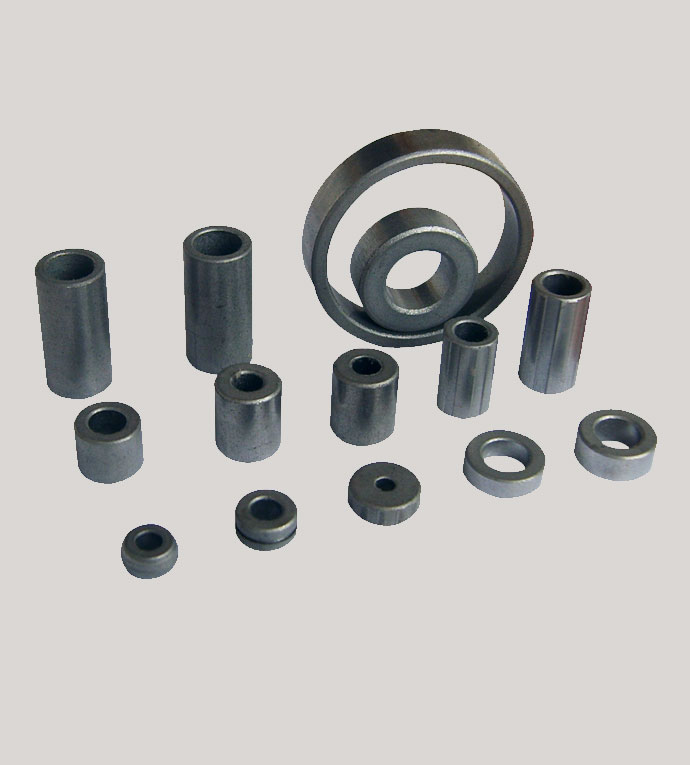

Sintered Iron Bushes Parts
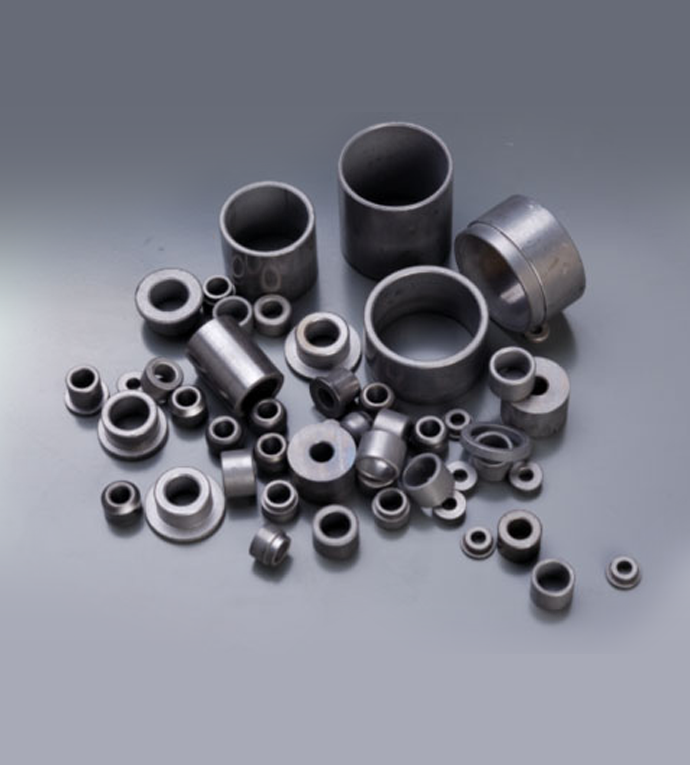
Manufacturing process of Sintered Iron Bush
In the Manufacturing process (Powder Metallurgy) fine iron powder is compressed in a die to form the bush shape. It is then heated below its melting point (a process called sintering). During sintering, particles bond together but do not fully melt, leaving tiny interconnected pores inside the material.
The bush typically has 15–30% porosity. These microscopic pores act like reservoirs for lubricating oil. After sintering, the bush is soaked in lubricating oil (often under vacuum). The oil fills the pores completely. When the bush is in operation e.g., rotating shaft inside it, the heat generated by friction causes the oil inside the pores to expand. The oil is forced out onto the surface, forming a thin lubricating film between the shaft and bush. When the system stops and cools the oil is drawn back into the pores due to capillary action. This continuous cycle ensures automatic lubrication without external oiling. The oil film reduces metal-to-metal contact. This results in lower friction, reduced wear and longer service life.
Key Advantages of Sintered Iron Bush
- Maintenance-free (no frequent lubrication needed)
- Quiet operation
- Cost-effective for mass production
- Good performance in moderate loads and speeds
Technical Specification of Sintered Iron Bush:
| Category | Specification |
|---|---|
| Material & Manufacturing | |
| Material | Iron-based powder (often SAE 863 or similar) |
| Process | Powder compaction → Sintering → Sizing → Oil impregnation |
| Structure | Porous (typically 20–25% porosity) for oil retention |
| Physical Properties | |
| Density | 6.0 – 6.8 g/cm³ |
| Hardness | 35 – 50 HRB |
| Oil Content | Approximately 15–25% (by volume) |
| Surface Finish | 0.8 – 1.6 µm (typical) |
| Mechanical Properties | |
| Coefficient of Friction | ~0.05 – 0.20 (self-lubricated range) |
| Operating Conditions | |
| Working Temperature | Typical: –20°C to +120°C |
| Maximum Sliding Speed | Up to 5 m/s |
| PV Value (Pressure × Velocity) | Approximately 1.0 – 1.5 MPa·m/s (dry condition) |
Typical specifications:
| Property | Typical Value |
|---|---|
| Density | 6.2–7.2 g/cm³ |
| Porosity | 10–30% |
| Operating Temperature | -20°C to 120°C (oil-impregnated); higher with special lubricants |
| Coefficient of Friction | 0.05–0.15 (lubricated) |
| Compressive Strength | 300–700 MPa |
Design considerations of Iron Sintered Bush:
When selecting an Iron Sintered Bush, consider:
- Shaft diameter
- Radial load
- Rotational speed
- PV value (pressure × velocity)
- Operating temperature
- Lubrication method
- Shaft surface finish
- Running clearance
- Environmental conditions (dust, moisture, chemicals)
Maintenance
For self-lubricating bushes:- Usually maintenance-free under normal operating conditions.
- Keep contaminants out.
- Avoid overheating.
- Replace if excessive clearance or wear develops.
- Lubricate according to the equipment manufacturer's schedule.
- Inspect periodically for wear and alignment.
Iron sintered bushes are a popular bearing solution because they combine economical production with reliable performance. Their porous structure enables oil retention for self-lubrication, making them well suited to applications requiring low maintenance, quiet operation, and long service life under moderate loads and speeds.
Types of Sintered Iron Bush:
Sintered Iron Bushes (also called
Powder Metal Bushes) are widely used for self-lubricating
and wear-resistant applications.
They’re typically categorized based on composition, lubrication
method, and application.
- Oil-Impregnated Sintered Iron Bushes
- Dry Sintered Iron Bushes
- Iron-Graphite Bushes
- Iron-Copper (Fe-Cu) Sintered Bushes
- Iron-Carbon Sintered Bushes
- Self-Lubricating Composite Bushes
- Flanged Sintered Bushes
- Custom Alloy Sintered Bushes
Iron Bush application industries:
Sintered iron bushings (also called powder metallurgy iron bushes) are widely used as bearings and wear-resistant components in industries where low friction, durability, and cost-effectiveness are important.
Common application industries include:- Automotive Industry: Starter motors, Alternators, Windshield wiper motors, Steering systems, Clutch and transmission assemblies, Suspension components, Seat adjustment mechanisms.
- Electric Motors & Pumps: AC/DC electric motors, Water pumps, Cooling fans, Vacuum pumps, Compressors
- Industrial Machinery: Conveyor systems, Textile machinery, Packaging equipment, Printing machines, Material handling equipment.
- Agricultural Machinery: Tractors, Seed drills, Harvesters, Irrigation equipment.
- Power Tools: Electric drills, Angle grinders, Circular saws, Sanders
- Construction Equipment: Concrete mixers, Compactors, Cranes, Earthmoving equipment.
- Mining Equipment: Crushers, Screening machines, Material conveyors.
- Medical & Laboratory Equipment: Diagnostic instruments, Laboratory mixers, Small medical motors.
- Renewable Energy: Small wind turbines, Solar tracking systems, Gear drives and actuators.