


Sintered Bronze Filter
Bearing and Bush Co is widely acclaimed as one of the renowned
leading Manufacturers & Exporters of an assortment of
Bearing, Bushes, Dry Washer, Flanged Washer, and parts
that are utilized in automotive industry.
The durability, tensile strength, and dimensional accuracy of our goods,which include Dry Washers
and Flanged Washers, are well known across the world.
Furthermore, we provide our clients customized solutions according to their needs.
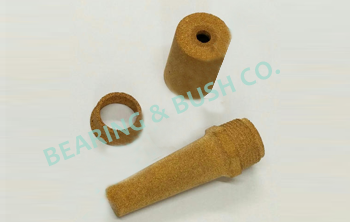

Sintered Bronze Filters are porous metal filtration components manufactured by compressing bronze powder into a desired shape and then heating it below its melting point. This sintering process creates a rigid structure with interconnected microscopic pores that allow fluids or gases to pass while trapping contaminants.
Key Features of Sintered Bronze Filters:
- Uniform Porosity – Consistent pore distribution ensures reliable filtration performance.
- High Mechanical Strength – Self-supporting structure withstands pressure and vibration.
- Excellent Corrosion Resistance – Suitable for oils, fuels, gases, and many industrial fluids.
- Thermal Stability – Can operate at elevated temperatures, often up to around 250–300°C depending on design and atmosphere.
- Reusability – Can be cleaned by backflushing, ultrasonic cleaning, or solvent cleaning.
- High Dirt-Holding Capacity – Depth filtration captures particles throughout the porous structure, not just on the surface.
- Withstands Temperatures up to 250 0 C
- Available in various sizes up to 1 meter L
- Filtration Levels: 1 to 100 microns
- Stable Pore Size due to Sintering Process
- Low Pressure Drop Low Pressure Drop
Working Principle of Sintered Bronze Filters:
The working principle of Sintered Bronze Filters is based on depth filtration and surface filtration.
Sintered Bronze Filters are porous filtration components manufactured by compacting and heating bronze powder at high temperatures below its melting point. This process creates a strong, rigid structure with interconnected microscopic pores that enable efficient filtration.
The liquid or gas containing contaminants enters the filter element from the outer or inner surface, depending on the system design. As the fluid passes through the interconnected pores larger particles are trapped on the filter surface (surface filtration). Smaller particles penetrate deeper and get captured within the porous structure (depth filtration). This multi-layer filtration ensures high contaminant retention efficiency.
After impurities are removed, the clean fluid or gas exits through the opposite side of the filter element. The uniform pore distribution helps maintain consistent flow rates while minimizing pressure drop across the filter. When clogged, the filter can often be cleaned using Backflushing, Ultrasonic cleaning, Solvent washing or Compressed air cleaning. This makes sintered bronze filters economical for long-term use.
The filtration process typically combines:
- Mechanical interception – particles larger than pore size are blocked.
- Inertial impaction – heavier particles collide with pore walls.
- Diffusion capture – very fine particles adhere to internal surfaces.
- Adsorption effects – some contaminants attach to the bronze surface.
Applications of Sintered Bronze Filters:
Sintered Bronze Filters are widely used across industries for efficient filtration, flow control, gas diffusion, and noise reduction. Their porous structure, high mechanical strength, corrosion resistance, and ability to operate under high temperatures make them suitable for demanding industrial applications.
- Chemical Processing Industry - Used for filtering aggressive chemicals, solvents, acids, and process fluids where consistent filtration performance is critical.
- Pharmaceutical Industry - Applied in sterile air filtration, gas purification, solvent filtration, and process equipment requiring contamination-free operations.
- Food & Beverage Industry - Used for filtration of compressed air, steam, water, oils, and gases in hygienic production environments.
- Petrochemical & Oil Industry - Suitable for filtering fuels, lubricants, hydraulic oils, and process gases under high pressure and temperature conditions.
- Pneumatic Systems - Used as silencers, mufflers, and air exhaust filters in pneumatic valves, cylinders, compressors, and automation systems.
- Automotive Industry - Applied in fuel filtration, lubrication systems, emission control systems, and air filtration components.
- Water Treatment Systems - Used for removing suspended particles and contaminants from industrial water processing systems.
- Electronics & Semiconductor Industry - Provides ultra-fine gas filtration and contamination control in sensitive manufacturing environments.
- Medical Equipment - Used in oxygen concentrators, respiratory devices, sterilization systems, and medical gas filtration applications.
- Power Generation Industry - Applied in turbine lubrication systems, coolant filtration, and compressed gas purification.
- Instrumentation & Analytical Equipment - Used for protecting sensitive measuring instruments from dust, moisture, and particulate contamination.
- Aerospace & Defense - Suitable for hydraulic systems, fuel systems, and high-performance filtration applications requiring reliability.
- Environmental & Pollution Control - Used in dust collection systems, gas emission control, and air purification systems.
- Industrial Machinery -Installed in hydraulic systems, lubrication circuits, compressors, pumps, and process equipment for long-term equipment protection.
- Gas Distribution & Diffusion Applications - Used for gas sparging, aeration, flame arresting, and uniform gas dispersion in industrial processes.